Too Many Holes: The Engineering Nightmare Behind Port-Packed Portable Devices
There's a complaint you'll find in virtually every comment section under any portable device review: "Why did they remove the headphone jack?" Or the microSD slot. Or the second USB-C port. Users want more holes in their gadgets, and honestly, that's a fair ask on the surface. More ports equal more flexibility, right?
Not exactly. And if you spend a little time talking to the people who actually design these things, you start to realize that every cutout in a compact chassis is less a feature and more a calculated gamble.
The Space Problem Nobody Talks About
Here's the thing about a device smaller than your palm — it's essentially a three-dimensional puzzle where every cubic millimeter is spoken for. Batteries are getting bigger. Cooling systems are getting more elaborate. Cameras are stacking up like apartment buildings. And somewhere in that shrinking real estate, engineers are expected to wedge in USB-C ports, microSD trays, SIM slots, proprietary connectors, and yes, possibly a headphone jack.
When hardware engineers describe port placement, they don't talk about it like a wish list. They talk about it like triage. "Every opening we add is a structural compromise," one thermal engineer working on handheld gaming hardware told us. "The chassis wall gets thinner, the internal bracing has to shift, and suddenly you've traded rigidity for a feature that maybe 30% of your users actually use."
That rigidity matters more than most people think. Drop tests, flex tests, long-term fatigue from repeated port insertions — a device with six ports is fundamentally more fragile than one with two, everything else being equal. The more holes you punch in a chassis, the more you're relying on the remaining material to hold everything together.
Heat Is the Real Enemy
If structural integrity is the first problem, thermal management is the second — and it's arguably worse.
Modern processors in handhelds and compact PCs generate serious heat under load. The entire internal layout of a device is often designed around managing that heat: copper heat spreaders, graphite sheets, strategic airflow channels in devices that actually have fans. Ports disrupt all of that.
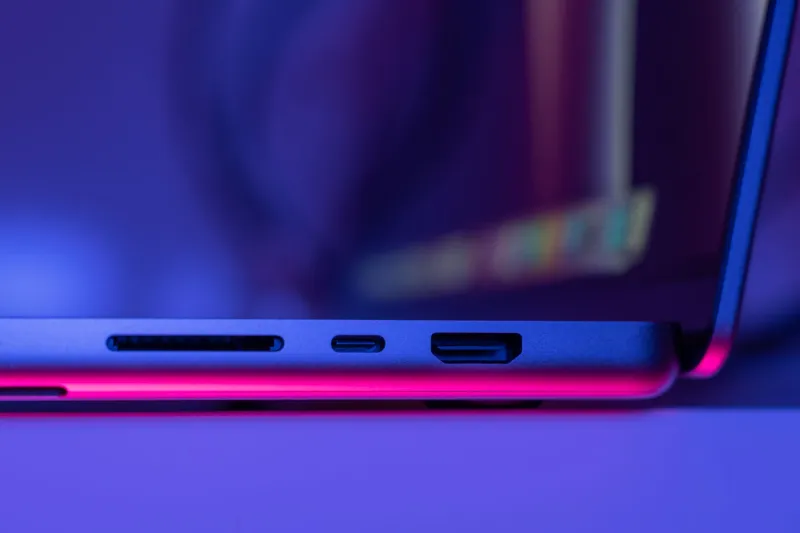
A USB-C port isn't just a hole for a cable. It's a gap in the thermal envelope. Air that should be channeled across a heat spreader can leak through connector openings. Worse, high-speed data transfer through USB 4 or Thunderbolt generates its own heat at the connector itself — heat that has nowhere to go in a sealed, pocket-sized device.
Thermal analysis data from third-party teardown labs has shown that devices with dense port arrays can run measurably hotter at sustained loads than comparable devices with fewer connections — sometimes by as much as 4–6°C in the area surrounding port clusters. That might not sound like much, but modern chips start throttling performance at temperature thresholds that are closer than most people realize. You're essentially trading sustained processing power for the convenience of having that extra port available.
EMI: The Invisible Interference
Electromagnetic interference doesn't get nearly enough attention in mainstream tech coverage, but electrical engineers lose sleep over it.
Every port is a potential antenna. Every cable you plug in extends that antenna further. In a compact device where a cellular modem, Wi-Fi radio, Bluetooth chip, and high-speed processor are all operating within inches of each other, the EMI situation is already complicated. Add more ports — especially if users are running multiple cables simultaneously — and you've introduced new interference pathways that can degrade wireless performance, introduce audio noise, and cause unpredictable behavior in sensors.
This is part of why some manufacturers have moved toward single-port designs or tightly controlled port combinations rather than simply adding every connector a user could want. It's not laziness. It's RF engineering reality.
So Why Do Users Keep Demanding More?
Because from the outside, a port is free. You see a spec sheet that says "2x USB-C, microSD, 3.5mm" and it reads as more value than "1x USB-C." Marketing has trained consumers to treat connectivity as a checklist item rather than an engineering decision.
And to be fair, the frustration is legitimate. Dongle life is genuinely annoying. Having to carry a hub to connect a mouse, a drive, and a display to your handheld PC is a real inconvenience that real people deal with every day.
But the solution isn't necessarily to punch more holes. Some manufacturers are exploring magnetic connector systems that maintain a sealed chassis while providing multi-function connectivity. Others are leaning harder into wireless peripherals and high-speed Wi-Fi as a substitute for wired connections. Neither approach is perfect, but both sidestep the thermal and structural penalties of traditional ports.
The Honest Tradeoff
Here's where we land: there's no version of a compact, powerful, durable portable device that has every port you want and pays no engineering price for it. The physics don't allow it.
What you can reasonably ask for is transparency. Manufacturers should be upfront about why certain ports were cut and what was gained in exchange — whether that's battery life, sustained performance under load, or simply a device that survives a two-foot drop onto concrete. Right now, that conversation rarely happens. Instead, you get marketing copy about "clean design" that papers over real engineering decisions.
The next time a device ships without the port you wanted, it's worth asking what you got in return. Sometimes the answer is genuinely nothing — it was just a cost-cutting move. But sometimes, that missing hole is the reason your device runs cool, stays rigid, and keeps working three years later.
And that's a tradeoff worth at least thinking about.