Cramped Screen, Clearer Mind: The Surprising Reason Pocket PCs Make You Get More Done
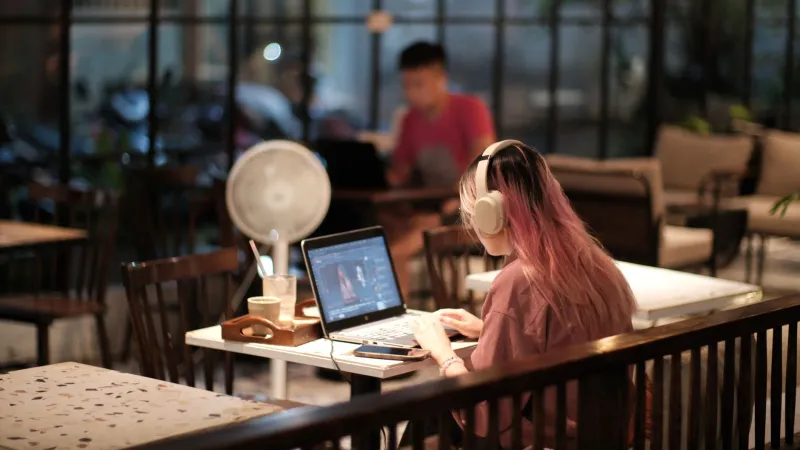
Everybody assumes that more screen real estate means more work gets done. It's practically gospel in productivity circles — get a bigger monitor, spread out your windows, multitask like a pro. And yet, a quiet but growing crowd of remote workers, developers, and digital nomads is pushing back on that idea in the most literal way possible: they've traded in their 15-inch laptops for palm-sized pocket PCs, and they swear they've never been more productive.
That sounds like the kind of thing someone says to justify an expensive gadget purchase. But spend some time digging into the psychology and the real-world workflows behind this shift, and the logic starts to hold up in some genuinely interesting ways.
The Constraint Advantage Nobody Talks About
Here's the core idea: when your screen is small, you can't multitask the same way. You can't have twelve browser tabs open alongside a Slack window, a Spotify mini-player, and a half-finished spreadsheet all competing for your attention at once. You're forced — almost involuntarily — to work on one thing at a time.
Psychologists have a name for what happens when you try to juggle too many tasks simultaneously: attention residue. Every time you switch from one task to another, a fragment of your mental bandwidth stays stuck on what you just left. The more windows you have open, the more residue accumulates, and the harder it becomes to do any single thing well.
Small screens don't give you a choice. One app. One task. One window of focus. And for a lot of people, that's exactly the constraint they needed.
Mike Reston, a freelance software developer based out of Austin, Texas, made the switch to a GPD Pocket 3 about a year ago after burning out on what he calls "screen sprawl."
"I had a dual-monitor setup, and I thought I was being super efficient," he says. "But I was actually just context-switching constantly. I'd be in the middle of writing a function and drift over to check email, then Reddit, then back. With the pocket PC, there's no room for that. I'm either writing code or I'm not."
He reports finishing projects roughly 20% faster since making the switch — not because the hardware is faster, but because his brain is.
Notification Fatigue Is Real, and Small Screens Fight It
There's another angle here that doesn't get enough credit: notification management. On a large laptop or desktop, notifications are everywhere. A banner slides in from the top right, a badge pulses on the taskbar, a chat bubble bobs in the corner. Each one is a tiny interruption, and interruptions are expensive — research from the University of California, Irvine found that it takes an average of over 23 minutes to fully regain focus after a distraction.
Pocket PCs, by their nature, tend to run leaner. Users running Windows on compact devices like the AYANEO Pocket S or the Minisforum V3 often report that the setup process itself encourages them to strip down their software stack. You're working with limited screen space and, in some cases, limited processing headroom. Bloatware gets cut. Notification-heavy apps get uninstalled or silenced. The device almost demands a minimalist configuration.
Jessica Tam, a content strategist who works remotely from Portland, Oregon, describes her pocket PC as a "distraction firewall."
"I still have my big laptop for design work when I need it," she explains. "But when I need to actually write? I grab the small one. There's no room for anything else. It's just me and the document."
The Focus Ritual Effect
There's also something to be said for the psychological power of physical context. Behavioral researchers have long known that environment shapes behavior — it's part of why people find it easier to work in a coffee shop than on their couch. A dedicated device for focused work creates a similar mental trigger.
When you open a pocket PC specifically for a writing session or a coding block, your brain starts to associate that form factor with focused effort. It becomes a ritual cue. You're not "going online" — you're going to work. The physical act of picking up a small, deliberate device signals intent in a way that opening another tab on your existing laptop simply doesn't.
What the Skeptics Get Right
None of this is to say pocket PCs are for everyone, or that bigger screens don't have real advantages. Video editing, graphic design, spreadsheet-heavy financial work — these genuinely benefit from more screen space. Nobody's arguing otherwise.
And there's a real learning curve. Text is smaller. Navigation can be fiddly. If you have any vision issues, working on a 6- or 7-inch display for hours at a time isn't going to be comfortable. Ergonomics matter, and it's worth being honest about that.
But the productivity argument for small screens isn't really about the screen itself. It's about what the small screen forces you to do — and, more importantly, what it stops you from doing. For a meaningful slice of knowledge workers, that forced simplicity is the killer feature that no spec sheet ever lists.
The Bigger Picture
As pocket PCs get more powerful and more capable, the temptation will be to use them just like full-sized laptops — loading them up with apps, enabling every notification, multitasking until the focus advantage disappears entirely. The hardware is already there. Devices running Snapdragon X chips or AMD Ryzen Z2 silicon can handle a serious workload.
The people who seem to get the most out of compact devices are the ones who resist that temptation. They treat the small screen not as a limitation to overcome, but as a feature to protect.
That's a mindset shift more than a hardware decision. But if the result is actually getting things done instead of just feeling busy, it might be the most productive upgrade you make all year.